平衡二叉树之红黑树(Red-Black Tree)简介及Java实现
红黑树简介
红黑树(Red-Black Tree)也是一种自平衡二叉查找树,在前面的文当中,我们已经描述了AVL树了。AVL树与红黑树很像,因此也经常被放到一起比较。
与其他平衡二叉树不同,红黑树的每个节点有个额外的位来存储节点的颜色(红色或者黑色)。这些颜色位保证了在树的插入和删除时能保持平衡。
尽管红黑树的平衡不是完美的,但是它也足够保证搜索的时间效率为$O(\log n)$。追踪节点的颜色仅仅需要每个节点多保存一位数据,因为它只有两种颜色。除此之外,它不保存任何其他信息,因此,它的内存使用和典型的二叉查找树差不多,并不会造成额外的内存占用。
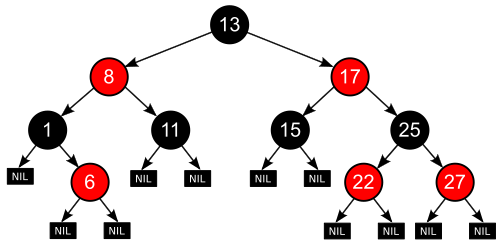
红黑树依靠节点的颜色来调整树的平衡(这和AVL树使用平衡因子来判断类似,后面会具体描述),其对颜色的要求如下:
- 每个节点只能是红色或者黑色两种
- 根节点是黑色的(但是这个规则有时候也不提,因为根节点总是可以从红色变成黑色,但是反过来不一定,它对分析的影响很小)
- 所有的叶子节点(NIL)都是黑色的
- 如果一个节点是红色的,那么它所有的子节点都是黑色的
- 从给定的节点到它的后代叶子节点中包含的黑色节点数量是一样的
这里说一下红黑树的叶子节点是不包含任何信息的,这些叶子不需要在计算机内存中显式存在,使用空子指针就可以编码这个叶子节点。但是如果叶子确实是显式节点,它会简化了一些在红黑树上操作的算法。所以,为了节省执行时间,有时指向单个sentinel节点(而不是空指针)的指针执行所有叶节点的角色; 从内部节点到叶节点的所有引用然后指向sentinel节点。因此,通常也称红黑树的叶子节点为NIL节点(NIL Leaves,NIL是0的意思,暗指不包含任何信息)。
如下图就是一个典型的红黑树:
红黑树的自平衡调整
红黑树的插入和删除操作会破坏树的颜色结构,所以需要重新调整节点的颜色来保证红黑树的性质符合上述要求,但这种操作消耗的计算也很小,因此依然可以保证时间复杂度在$O(\log n)$。
红黑树的调整包括旋转和变色两种。根据具体不同的情况来操作。以插入数据为例,典型的二叉查找树的插入操作是顺着二叉树向下,把新元素变成新的叶子节点。但是在红黑树中的操作不是这样,新元素的键会根据典型的二叉搜索树往下寻找,到大叶子节点(NIL 节点)后,会将该叶子节点去掉,然后把这个新元素变成这里的节点,并在新元素后面添加两个叶子节点。同时,该新节点的颜色是红色,新加的叶子节点的颜色是黑色。
完成上述操作之后,需要根据新加的节点周围的节点情况(这里共有4中case,后面表格中的case编号对应这里的情况)来进行调整(假设新加的节点是N):
- N是根节点
- N的父节点P是黑色的
- N的父节点P是红色的且N的叔叔节点U是红色的
- N的父节点P是红色的且N的叔叔节点U是黑色的
在前面的规则中:
- 规则1(每个节点要么是红色要么是黑色)和规则3(所有的叶子节点都是黑色)总是成立。
- 规则2(根节点是黑色)在插入第一个节点的时候就能保证。
- 规则4(红色节点只能有黑色的子节点)可能会在插入新节点时候(因为新加的节点都是红色),将节点的黑色变成红色操作的时候以及旋转的时候被破坏。
- 规则5(给定节点到所有叶子节点的路径上黑色节点数量是一样的)会在加入一个黑色节点、变色以及旋转的时候被破坏。
上述四种情况对应的操作如下:
红黑树与AVL树的比较
红黑树与AVL树相比没有那么严格的平衡,但是查找、插入和删除的效率是一样的。因此在实际中红黑树更广泛被使用。因为红黑树的实现相对简单,在常规操作上也更容易。JDK里面的TreeMap、TreeSet和HashMap(JDK 8)都使用红黑树来实现。
值得注意的是,在插入操作的时候,AVL树需要执行的旋转次数更多,有$O(\log n)$,而后者只需要$O(1)$。更多的旋转意味着更多的内存写入,这也是耗时的操作。所以更新操作的时候红黑树比AVL树更快。
具体的,StackOverflow上也有人给了一个比较:
对于小数据集:
- 插入操作:红黑树和AVL树最坏旋转次数一样的,但是红黑树的平均旋转次数更少,因此速度更快。
- 查找操作:AVL树更快,因为它的深度更小
- 删除操作:AVL树最坏情况下旋转次数比红黑树多,平均旋转次数也比红黑树多,因此红黑树嘟嘟更快。
对于大规模数据集:
- 插入操作:由于二者都是以最坏的情况旋转,而插入之前还需要进行查找操作,AVL查找速度更快,因此AVL效率更好。
- 查找操作:AVL树更快,理由如上
- 删除操作:AVL树平均来说更好,但是最坏的情况下红黑树更快。
红黑树的Java实现
package com.huawei.machinelearning.data.structure;// RedBlackTree class
//
// CONSTRUCTION: with a negative infinity sentinel
//
// ******************PUBLIC OPERATIONS*********************
// void insert( x )       --> Insert x
// void remove( x )       --> Remove x (unimplemented)
// Comparable find( x )   --> Return item that matches x
// Comparable findMin( )  --> Return smallest item
// Comparable findMax( )  --> Return largest item
// boolean isEmpty( )     --> Return true if empty; else false
// void makeEmpty( )      --> Remove all items
// void printTree( )      --> Print all items
// ******************ERRORS********************************
// Exceptions are thrown by insert if warranted and remove.

/**
 * Implements a red-black tree.
 * Note that all "matching" is based on the compareTo method.
 * @author Mark Allen Weiss
 */
public class RedBlackTree {
  /**
   * Construct the tree.
   */
  public RedBlackTree( ) {
    header      = new RedBlackNode( null );
    header.left = header.right = nullNode;
  }

  /**
   * Compare item and t.element, using compareTo, with
   * caveat that if t is header, then item is always larger.
   * This routine is called if is possible that t is header.
   * If it is not possible for t to be header, use compareTo directly.
   */
  private final int compare( Comparable item, RedBlackNode t ) {
    if( t == header )
      return 1;
    else
      return item.compareTo( t.element );
  }

  /**
   * Insert into the tree.
   * @param item the item to insert.
   * @throws DuplicateItemException if item is already present.
   */
  public void insert( Comparable item ) {
    current = parent = grand = header;
    nullNode.element = item;

    while( compare( item, current )!= 0 ) {
      great = grand; grand = parent; parent = current;
      current = compare( item, current ) < 0?
              current.left: current.right;

      // Check if two red children; fix if so
      if( current.left.color == RED && current.right.color == RED )
        handleReorient( item );
    }

    // Insertion fails if already present
    if( current!= nullNode )
      throw new DuplicateItemException( item.toString( ) );
    current = new RedBlackNode( item, nullNode, nullNode );

    // Attach to parent
    if( compare( item, parent ) < 0 )
      parent.left = current;
    else
      parent.right = current;
    handleReorient( item );
  }

  /**
   * Remove from the tree.
   * @param x the item to remove.
   * @throws UnsupportedOperationException if called.
   */
  public void remove( Comparable x ) {
    throw new UnsupportedOperationException( );
  }

  /**
   * Find the smallest item  the tree.
   * @return the smallest item or null if empty.
   */
  public Comparable findMin( ) {
    if( isEmpty( ) )
      return null;

    RedBlackNode itr = header.right;

    while( itr.left!= nullNode )
      itr = itr.left;

    return itr.element;
  }

  /**
   * Find the largest item in the tree.
   * @return the largest item or null if empty.
   */
  public Comparable findMax( ) {
    if( isEmpty( ) )
      return null;

    RedBlackNode itr = header.right;

    while( itr.right!= nullNode )
      itr = itr.right;

    return itr.element;
  }

  /**
   * Find an item in the tree.
   * @param x the item to search for.
   * @return the matching item or null if not found.
   */
  public Comparable find( Comparable x ) {
    nullNode.element = x;
    current = header.right;

    for(;; ) {
      if( x.compareTo( current.element ) < 0 )
        current = current.left;
      else if( x.compareTo( current.element ) > 0 )
        current = current.right;
      else if( current!= nullNode )
        return current.element;
      else
        return null;
    }
  }

  /**
   * Make the tree logically empty.
   */
  public void makeEmpty( ) {
    header.right = nullNode;
  }

  /**
   * Print all items.
   */
  public void printTree( ) {
    printTree( header.right );
  }

  /**
   * Internal method to print a subtree in sorted order.
   * @param t the node that roots the tree.
   */
  private void printTree( RedBlackNode t ) {
    if( t!= nullNode ) {
      printTree( t.left );
      System.out.println( t.element );
      printTree( t.right );
    }
  }

  /**
   * Test if the tree is logically empty.
   * @return true if empty, false otherwise.
   */
  public boolean isEmpty( ) {
    return header.right == nullNode;
  }

  /**
   * Internal routine that is called during an insertion
   * if a node has two red children. Performs flip and rotations.
   * @param item the item being inserted.
   */
  private void handleReorient( Comparable item ) {
    // Do the color flip
    current.color = RED;
    current.left.color = BLACK;
    current.right.color = BLACK;

    if( parent.color == RED )   // Have to rotate
    {
      grand.color = RED;
      if( ( compare( item, grand ) < 0 )!=
              ( compare( item, parent ) < 0 ) )
        parent = rotate( item, grand );  // Start dbl rotate
      current = rotate( item, great );
      current.color = BLACK;
    }
    header.right.color = BLACK; // Make root black
  }

  /**
   * Internal routine that performs a single or double rotation.
   * Because the result is attached to the parent, there are four cases.
   * Called by handleReorient.
   * @param item the item in handleReorient.
   * @param parent the parent of the root of the rotated subtree.
   * @return the root of the rotated subtree.
   */
  private RedBlackNode rotate( Comparable item, RedBlackNode parent ) {
    if( compare( item, parent ) < 0 )
      return parent.left = compare( item, parent.left ) < 0?
              rotateWithLeftChild( parent.left ):  // LL
              rotateWithRightChild( parent.left );  // LR
    else
      return parent.right = compare( item, parent.right ) < 0?
              rotateWithLeftChild( parent.right ):  // RL
              rotateWithRightChild( parent.right );  // RR
  }

  /**
   * Rotate binary tree node with left child.
   */
  private static RedBlackNode rotateWithLeftChild( RedBlackNode k2 ) {
    RedBlackNode k1 = k2.left;
    k2.left = k1.right;
    k1.right = k2;
    return k1;
  }

  /**
   * Rotate binary tree node with right child.
   */
  private static RedBlackNode rotateWithRightChild( RedBlackNode k1 ) {
    RedBlackNode k2 = k1.right;
    k1.right = k2.left;
    k2.left = k1;
    return k2;
  }

  private static class RedBlackNode {
    // Constructors
    RedBlackNode( Comparable theElement ) {
      this( theElement, null, null );
    }

    RedBlackNode( Comparable theElement, RedBlackNode lt, RedBlackNode rt ) {
      element  = theElement;
      left     = lt;
      right    = rt;
      color    = RedBlackTree.BLACK;
    }

    Comparable   element;    // The data in the node
    RedBlackNode left;       // Left child
    RedBlackNode right;      // Right child
    int          color;      // Color
  }

  private RedBlackNode header;
  private static RedBlackNode nullNode;
  static         // Static initializer for nullNode
  {
    nullNode = new RedBlackNode( null );
    nullNode.left = nullNode.right = nullNode;
  }

  private static final int BLACK = 1;    // Black must be 1
  private static final int RED   = 0;

  // Used in insert routine and its helpers
  private static RedBlackNode current;
  private static RedBlackNode parent;
  private static RedBlackNode grand;
  private static RedBlackNode great;

  // Test program
  public static void main( String [ ] args ) {
    RedBlackTree t = new RedBlackTree( );
    final int NUMS = 400000;
    final int GAP  =  35461;

    System.out.println( "Checking... (no more output means success)" );

    for( int i = GAP; i!= 0; i = ( i + GAP ) % NUMS )
      t.insert( new Integer( i ) );

    if( ((Integer)(t.findMin( ))).intValue( )!= 1 ||
            ((Integer)(t.findMax( ))).intValue( )!= NUMS - 1 )
      System.out.println( "FindMin or FindMax error!" );

    for( int i = 1; i < NUMS; i++ )
      if( ((Integer)(t.find( new Integer( i ) ))).intValue( )!= i )
        System.out.println( "Find error1!" );
  }
}

/**
 * Exception class for duplicate item errors
 * in search tree insertions.
 * @author Mark Allen Weiss
 */
class DuplicateItemException extends RuntimeException
{
  /**
   * Construct this exception object.
   */
  public DuplicateItemException( )
  {
    super( );
  }
  /**
   * Construct this exception object.
   * @param message the error message.
   */
  public DuplicateItemException( String message )
  {
    super( message );
  }
}
参考文献:
https://stackoverflow.com/questions/16257761/difference-between-red-black-trees-and-avl-trees https://www.java-tips.org/java-se-tips-100019/24-java-lang/1904-red-black-tree-implementation-in-java.html https://en.wikipedia.org/wiki/Red%E2%80%93black_tree
DataLearner 官方微信
欢迎关注 DataLearner 官方微信,获得最新 AI 技术推送